Financial Fundamentals – What Is Retirement Planning? A Guide to Savings, Income, and Strategy
What’s Included:
- What retirement planning is and why it matters
- How much money you may need to retire
- Common sources of retirement income
- 401(k)s, IRAs, and Roth retirement accounts
- Retirement savings and investing strategies
- Tax planning considerations in retirement
- Inflation, market volatility, and longevity risks
- When to start planning for retirement
- Creating a personalized retirement strategy
What is Retirement Planning?
Retirement planning is the process of creating a long-term plan for saving, investing, and withdrawing money for retirement. Retirement planning is specific to you – whatever you picture when imagining a comfortable life after your working years, that is what your retirement plan should aim to achieve.
A thorough retirement plan will include an understanding of your estimated future expenses and create a strategic plan to cover those expenses for your life expectancy. The plan should incorporate all anticipated sources of retirement income, including pensions, Social Security, and personal retirement savings.
Personal retirement savings in corporate retirement plans, such as 401(k)s, and individual retirement accounts (IRAs) have become an increasingly important source of income for many retirees. Strategically saving and investing in these vehicles is a major component of successful retirement planning.
Why Retirement Planning Matters
The shift from career to retirement is a significant life transition. In addition to the financial change from earning an income to relying on savings, there are social, emotional, and psychological changes to navigate. Outside risks such as market volatility, inflation, and longevity raise the stakes. Solid retirement planning can help ease these transitions by clearly aligning future expenses with retirement income.
A retirement plan doesn’t start when you reach retirement age. In fact, time is an asset when it comes to preparing for retirement, and the earlier you start, the better. But whenever you start your retirement plan, the goal is the same – to create a roadmap to guide you to and through a retirement that maintains your current lifestyle.
How Much Do You Need to Retire?
There is no magic number, or concrete formula that can tell you exactly how much you need to retire. Your needs are unique to your current lifestyle, retirement goals, and age, health, and longevity expectations. That’s why it’s critical to craft your own personalized retirement plan.

That said, there are a few popular rules of thumb to get you started thinking about your retirement needs.
- Age-Based Savings Factor
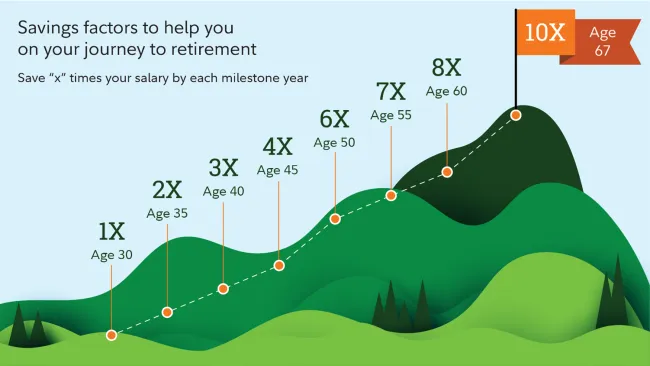
- The age-based savings factor rule of thumb states that starting at age 30, you should aim to have about 1x your annual salary saved for retirement. For example, if your annual salary is $100,000, you should aim to have that much saved for retirement by age 30. By age 35, the goal is 2x, or $200,000 in our example – possibly more if our example saver received any raises during that time. The savings factor increases by 1 for each milestone year until finally reaching 10x your annual salary in retirement savings by the age of 67.
- The 80% Rule
- According to the 80% rule, you will need about 80% of your current income to live comfortably during retirement. Based on this rule of thumb, if you make $100,000 a year leading up to retirement, you will need $80,000 of income per year during retirement. Multiply that by your life expectancy after retirement and you will get a very general picture of how much retirement savings you need.
- The 4% Rule
The 4% rule of thumb states that a “safe” withdrawal rate from your retirement savings is 4%, adjusted annually for inflation. With a retirement portfolio that is 50% stocks, 50% bonds and cash, withdrawing according to the 4% rule results in a low probability of outliving your money during a 30-year retirement, based on historical performance data.
Knowing that you can withdraw 4% annually, adjusted for inflation, can help you calculate the starting value of your retirement portfolio. For example, if you anticipate needing $40,000 of income during your first year of retirement, you will need a retirement portfolio totaling $1 million.
As you approach retirement age, you can forget rules of thumb and begin to construct a retirement budget that is unique to you. Include expenses such as housing, transportation, health insurance, and food and clothing. Also consider costs associated with your retirement goals, such as travel or entertainment. And don’t forget that you will have additional free time when you retire – allocating additional funds to hobbies may be a good idea. Your retirement budget will help you fine tune your saving and investment plan as retirement approaches.
What Is Retirement Income and How Does It Work?
Retirement income refers to the combination of funds you will use to pay your living expenses during retirement. Retirement income often combines several sources, including Social Security, pensions, and retirement accounts.
During your working years, you earn an income in exchange for work. For most, this income is paid through a steady paycheck. Others may have more variable income, such as commissions or bonuses, and still others may be entrepreneurs who depend on the success of their business for income. When you retire, this inflow of cash in exchange for work stops. Instead, you shift to living off a retirement income.
One common element of retirement income is Social Security. Social Security is a government benefit, available to individuals who worked and paid Social Security taxes for 10 years or more. You can apply for Social Security as early as age 62, but full benefits start between ages 66 and 67. And, benefits continue to increase if you choose to delay them, until age 70.
Another form of retirement income is an employer pension, or defined benefit plan. Employer pensions are a type of traditional retirement plan that pays a fixed monthly amount after retirement based on your salary history and tenure. Pensions are less common today among private companies, though they are still standard for government workers.

Annuities are insurance contracts designed to provide guaranteed, regular income payouts in exchange for a lump sum or series of premium payments. While annuities can provide secure and steady retirement income, they are complex and often have high fees when compared to other investment options.
For many retirees, Social Security and employer pensions alone are not sufficient to ensure that they can maintain their standard of living throughout retirement. To bridge this gap, personal retirement savings have become an increasingly important part of a retirement income strategy. Additional retirement income sources may include deferred compensation, stock options, real estate or business assets.
Best Ways to Save for Retirement
As stated above, the role of individual savings in retirement income has grown steadily over time. Luckily, there are many options for saving for retirement, each with their own pros, cons, rules, and regulations.
Employer-Sponsored Plans
Many employers, especially large organizations, sponsor a qualified retirement plan as a benefit of employment. For-profit organizations commonly offer 401(k) plans, while most non-profits have 403(b) plans and government employees have access to 457(b) plans. Contributions to the plans are typically deducted from your paycheck, making it easy to automate savings. Additionally, some employers provide a retirement plan match. These employers follow a set formula to contribute to your retirement savings account, typically matching your contribution up to a certain percent.
There are annual limits to how much you can save in an employer-sponsored plan. In 2026, the individual contribution limit is $24,500 to both traditional and Roth plans. This limit does not include an employer match. Additionally, if you are age 50 or older, you can contribute an additional catch-up contribution of up to $11,250 depending on your age.
Individual Retirement Plans (IRAs)
If your employer does not offer a retirement plan, consider saving in an Individual Retirement Account (IRA). IRAs are qualified retirement plans, so like employer-sponsored plans, there are limits on how much you can contribute. In 2026, the contribution limit for IRAs, including both traditional and Roth contributions, is $7,500. Savers that are age 50 or older can contribute an additional $1,100 as a catch-up contribution.
Qualified Retirement Plans
Qualified retirement plans, including employer-sponsored plans and Individual Retirement Accounts (IRAs) are tax-deferred. Contributions made directly to a workplace retirement plan use pre-tax dollars and contributions to IRAs may be tax-deductible, depending on your situation. Qualified retirement savings reduce your annual taxable income. Additionally, investments in these accounts are allowed to grow tax-deferred, increasing your growth potential.
Withdrawals from qualified accounts made during retirement are taxed as ordinary income. (Withdrawals made before retirement age face both taxes AND penalties). Savings in qualified accounts are subject to required minimum distributions (RMDs), starting when you reach age 73 or 75, depending on when you were born. RMDs are the government’s way to ensure that the funds in these accounts are eventually taxed.
Roth Accounts
Roth IRAs and Roth accounts within employer-sponsored retirement plans offer a different tax benefit. These accounts are funded with after-tax dollars. But withdrawals from Roth accounts are tax-free, including any growth on your retirement investments. Additionally, Roth accounts are not subject to RMDs during the original owner’s lifetime. This provides significant tax-planning flexibility during retirement. (Note, there are still penalties for withdrawing investment gains prior to retirement age.)
The contribution limit of $7,500, $8,600 for age 50 or older, counts toward both traditional and Roth IRA contributions. Additionally, Roth IRAs have income restrictions. To make the full contribution to a Roth IRA, a single filer’s Modified Adjusted Gross Income (MAGI) must be less than $153,000, $242,000 for those filing jointly. The eligible contribution amount decreases as MAGI increases, until filers become ineligible at $168,000 for single, $252,000 for joint.
Other Investments
If you have maxed out your tax-advantaged retirement savings options, it doesn’t mean you should stop saving. You can consider other investment opportunities, such as a taxable investment account, Certificates of deposit (CDs), alternative investments, or real estate. Diverse investments increase your options for retirement income and estate and legacy options. But not until after you’ve taken advantage of the tax-saving opportunities offered by traditional and Roth retirement accounts.
Investing for Retirement
Once you have set up a retirement account, you will also need to decide how to invest the funds you are saving. It is helpful to choose a target asset allocation – the proportion of stocks vs bonds and cash – that aligns with your risk tolerance and time horizon. Your asset allocation may change as you near retirement, often becoming more conservative as you near the transition from accumulating assets to withdrawing assets as part of your retirement income.
Employer-sponsored plans often have less investment flexibility than IRAs. Still, they usually include a selection of mutual funds and exchange-traded funds (ETFs) to choose from. Often, these include target-date funds, which automatically alter their asset allocation to become more conservative over time.
Key Retirement Planning Factors People Overlook
Seeing the Big Picture
Throughout your career, you may accumulate several employer-sponsored retirement plans.
If you are married, your spouse may also have a number of retirement plans. Combine that with your savings accounts, other investment accounts, pensions or annuities and your retirement income picture can get complicated, fast.
People who do not consolidate their qualified retirement plans as they approach retirement may struggle to see the big picture. Having consolidated qualified retirement plans can help you plan your cash flow and manage taxes. It can make it easier to maintain your asset allocation and rebalance your accounts when they become misaligned. It can also make calculating RMDs and updating beneficiary designations more efficient.

Planning Around Taxes
Qualified retirement accounts are great tools for tax-advantaged savings, but the IRS comes for their cut eventually. Planning your retirement income around your anticipated tax bill is a key factor to successful retirement planning. And managing income tax brackets is only part of the equation. Your retirement income decisions can also affect the potential taxation of your Social Security benefits and the cost of Medicare premiums.

Considering Inflation
Inflation, even low levels of inflation, can have a major impact on your retirement savings over time. As investors near retirement, they often shift to more conservative investments. This approach makes sense but can be problematic if overdone. Assets in cash, CDs, and even bonds may feel safe, but actually lose purchasing power if they don’t keep pace with inflation. Finding – and sticking to – an asset allocation that balances market risk, inflation risk, and your personal risk tolerance and time horizon, is key to a successful retirement plan.
Preparing for Volatility
Having a flexible withdrawal strategy is increasingly important as you begin relying on your retirement account assets for income. Market volatility is a natural and expected part of investing. When you are accumulating funds, you can weather volatility by viewing it as a “sale,” and trusting that your investments will recover in time. During retirement, you may not have this option. You may need to make a withdrawal, either because you need the income or because of an RMD. This makes it especially important to have flexible options for withdrawals, including bonds and cash equivalents. Having a flexible withdrawal strategy prevents you from needing to sell invested assets during a period of down markets. Ensuring you have a withdrawal strategy in place for times of market volatility will help ensure your investments last as long as possible.
Estimating Life Expectancy
One of the most challenging retirement planning questions is: How many years will I live in retirement?
Obviously, this question is challenging because it is unknowable – none of us know what the future holds for us. But it can be hard to even estimate life expectancy, because the topic of our mortality makes it hard to consider the question objectively.
As a starting point, consider that on average an American at age 65 today will spend about 20 years in retirement. From there, consider your personal health and your family history. If your parents and grandparents lived far beyond this average, you should prepare a retirement income strategy that does so as well. Whatever number you come up with, increase it to create a comfortable margin of error. The longer you live, the more risks such as market volatility and inflation affect your plan.

When Should You Start Retirement Planning?
It is never too early or too late to plan for retirement. Early in your career, retirement may seem so far away that it isn’t worth saving for. But don’t underestimate the power of compounding over a long-time frame. Even if you are only able to put a modest amount away, with time on your side these early investments can grow to make a big impact on your retirement plan.

Mid-career tends to be a challenging time for retirement savings as families experience competing priorities. Mortgage(s), transportation, daycare, saving for college – the list goes on and on. Still, saving for retirement needs to make the list. Mid-career can be a good life stage to rely on automated savings into a qualified retirement plan to keep you on track. In particular, make sure you are taking full advantage of any employer matches available. Not doing so would be leaving retirement savings on the table. And make sure your savings are invested with an appropriate asset allocation. At this stage of life, it remains important to use time to your advantage.
Late in your career, ensuring you are on track to your retirement goals needs to become your priority. Often, this is when your income is at its highest, and you may find that your family-related spending priorities have wound down. You might consider taking advantage of the catch-up contributions available to retirement savers age 50 and older. You should also re-evaluate your investment allocation, as it makes sense for many investors to start investing more conservatively as they near retirement age.

The Bottom Line
Retirement planning is more than just saving in a retirement account – although that is an important part. Retirement planning is creating a long-term, strategic plan for how you will save, invest, and withdraw money to pay for your lifestyle during retirement.
Planning for retirement is especially challenging because of its long timeframe. You are attempting to plan your expenses and income, not just for the next year, or even the next few years, but for decades. The exact time frame is unknown, as are major components, including taxes, inflation, and healthcare. Having a thorough retirement plan can help you face these unknowns.
An ideal retirement looks different to everyone. You may want to travel the world, split your time between homes, stay near your family, volunteer, or even continue to work part time. Creating a retirement plan that is tailored to your unique vision of retirement will help you move forward with clarity and confidence.
SCHEDULE A 30 MINUTE WELCOME CALL
FAQ
What is retirement planning?
Retirement planning is the process of saving, investing, and creating a strategy to generate income throughout retirement while supporting your lifestyle and long-term goals.
How much money do I need to retire?
The amount you need depends on your lifestyle, expected expenses, retirement age, and income sources such as Social Security, pensions, and personal savings.
When should I start retirement planning?
It's never too early or too late to start. Beginning earlier gives your savings more time to grow through compounding and investment returns.
What are the best retirement savings accounts?
Common retirement savings options include 401(k) plans, 403(b) plans, 457(b) plans, traditional IRAs, and Roth IRAs, each with different tax benefits and rules.
What sources of income can I use in retirement?
Retirement income may come from sources such as Social Security, pensions, retirement accounts, annuities, taxable investment accounts, real estate, and other personal assets.
This guide should not be regarded as a complete analysis of the subjects discussed. All investment strategies have the potential for profit or loss. Changes in investment strategies, contributions or withdrawals, and economic conditions may significantly alter the performance of your retirement savings accounts. We cannot guarantee that your investments will match or outperform any specific benchmark. Asset allocation, rebalancing, and diversification will not necessarily improve an investor’s returns and cannot eliminate the risk of investment losses. Projections are based on assumptions that may not come to pass.
The views represented are not meant to be construed as advice. Moreover, no client or prospective client should assume that this content serves as the receipt of, or a substitute for, personalized advice from Affiance Financial, or from any other professional.
Content should not be viewed as legal or tax advice. You should always consult an attorney or tax professional regarding your specific legal or tax situation. Social Security, 401(k), IRA, and tax rules are subject to change any time. Always consult with your local Social Security office before acting upon any information provided herein.
Annuity guarantees are subject to the claims-paying ability of the issuing insurance company. If you withdraw money from or surrender your contract within a certain time after investing, the insurance company may assess a surrender charge. Withdrawals may be subject to tax penalties and income taxes.
Sources:
https://www.investopedia.com/terms/r/retirement-planning.asp
https://www.wellsfargoadvisors.com/planning/goals/retirement/six-retirement-steps.htm
https://www.wellsfargoadvisors.com/planning/goals/retirement/manage-ret-income.htm
https://www.fidelity.com/learning-center/personal-finance/average-retirement-savings
https://www.schwab.com/learn/story/beyond-4-rule-how-much-can-you-spend-retirement
https://www.fidelity.com/learning-center/smart-money/what-is-an-ira
https://www.ssa.gov/retirement