How to Maximize Your 401(k): 10 Smart Strategies for Retirement
What’s included:
- 401(k)s as part of your retirement savings plan
- 10 ways to maximize your 401(k)
- Contribution limits and options
- Employer match
- Vesting rules before leaving a job
- Investing for long-term growth
- Considering investment fees and expenses
- Avoiding early withdrawal penalties and taxes
- Catch-up contributions after age 50
- Roth 401(k)s
- Tracking and managing old 401(k) accounts
- Knowing when maxing out your 401(k) may not make sense
- Final thoughts
Corporate-sponsored 401(k) plans are among the most common investment accounts used for retirement savings. To help ensure you are making the most of this retirement planning vehicle, it’s essential to understand the opportunities and potential costs associated with maximizing your 401(k).
401(k) plans are named for a section of the U.S. Internal Revenue Code. They offer significant potential tax savings, but not without many accompanying rules and stipulations.
401(k)s as Part of Your Retirement Savings Plan
Most successful retirement plans include multiple sources of income.
A few of the ways retirees may pay for expenses during retirement include:
Social Security
Defined benefit plans or pensions
And individual retirement savings, such as 401(k) plans
The availability, as well as the proportional importance, of each of these income sources depends on the individual. But the trend since the mid-1980s has been an increased focus on the importance of individual retirement savings, particularly in 401(k) plans.
401(k) plans are the most common type of defined contribution plans (403(b) plans being a common option for certain employees of public schools, nonprofit organizations, and religious organizations).
In a defined contribution plan, employees choose to save a set amount or a set percentage of their paycheck for retirement. Employers may match worker contributions as a benefit of employment.
Contributions to a traditional 401(k) are pre-tax, meaning they reduce your earned income dollar-for-dollar. All dividends, interest, and earnings on contributions grow tax-deferred and are taxed as income when withdrawn in retirement.
Contributions to a Roth 401(k) plan are after-tax, meaning they are included in your income. But all dividends, interest, and earnings on contributions grow tax-free, and withdrawals are tax-free in retirement.
10 Ways to Maximize Your 401(k)

At first glance, 401(k) plans appear to be fairly straightforward retirement accounts. But, plan rules are dictated by the IRS. There is nuance to ensuring you maximize the potential benefits in a way that works best for your personal financial plan.
Consider the following tips to ensure you aren’t leaving valuable retirement savings on the table.
1. Understand your 401(k) contribution limits and options
Contributing to a 401(k) plan is typically part of your company’s payroll process - meaning that the funds are removed before your paycheck ever hits your bank account.
When establishing your employer-sponsored 401(k) account, your company may have recommended a default contribution based on a percentage of your salary. Any default setting is a great start, but it is likely far from the maximum savings available.
The golden rule for 401(k) contributions has traditionally been 10% of your gross earnings. Although some argue that this may be insufficient and should be closer to 15 or even 20%, the individual decision depends on several factors, including your age, proximity to retirement, anticipated retirement income needs, and the amount you can afford to save.

If you want to truly maximize your 401(k), it’s best to ignore general rules of thumb and aim to save the full amount of the annual contribution limit. For 2026, the IRS allows a maximum individual 401(k) contribution of $24,500 for those under age 50, and $32,500 for those aged 50 and older. This limit is periodically updated based on inflation.
To save the maximum amount allowed by the IRS, if you are paid twice monthly, you should save a little over $1,020 per paycheck if you are under 50, or about $1,354 per paycheck if you are 50 or older.
2. Maximize your employer 401(k) match
Arguably, one of the most important factors to consider when saving for a 401(k) account is an employer match. Employers that offer matching contributions typically use a specific formula to determine the amount of the match.
For example, an employer might contribute $0.50 to an employee’s 401(k) account for every $1 that the employee contributes, up to a certain percentage of the employee’s salary.
It is important to take advantage of any available employer match to your 401(k). Even if meeting your employer’s match is all you can afford to contribute, it will double the amount you are saving toward your retirement.
Doubling your savings today can have a meaningful impact on your account balance at retirement. Implementing this strategy will help ensure that you are not leaving any “free” retirement dollars on the table.
According to Lathrop GPM, 401(k) and matching contributions are particularly valuable when one is new in their career. This means it is crucial to understand your employer match options and implement this strategy as early as possible.
3. Understand 401(k) vesting rules before leaving a job
You always own 100% of the money you contribute to your 401(k). However, you may not own the full amount of an employer match you have received. This is due to vesting. Vesting refers to the percentage of 401(k) contributions that you own. Your contributions are automatically vested, but employer contributions may not be.
It’s essential to understand your company’s vesting requirements when considering a job change. Vesting is usually time-based. It can occur immediately, but more often, the percentage of vested employer contributions grows with your tenure at the company. At other times, the funds become fully vested all at once, but not until after a certain period.
If you change jobs before the full vesting period, you risk having your former employer reclaim the unvested portion of your 401(k).
4. Invest your 401(k) for long-term growth
Saving to a 401(k) account is only part of the equation - you also need to ensure your 401(k) is invested to give it the best chance to grow over a long period of time. Investing your 401(k) savings, especially early in life, allows you to take advantage of the power of compounding.
Compounding is a financial term that refers to the process of reinvesting interest or gains from an investment back into the investment, creating a cycle of gains over time. With the power of compounding, you are not only earning on your initial investment, but also on all of your reinvested interest and gains. Over time, compounding makes a significant difference in the growth of your savings.
Employees choose which investments to hold in their 401(k) accounts from a selection offered by their employer. Typical types of investments available in a 401(k) plan include stock and bond mutual funds and target-date funds, but they can also include a company’s stock or a guaranteed investment contract issued by an insurance company.
Target-date funds include a mix of stocks, bonds, and other securities, which are adjusted for risk as the fund’s target date approaches, becoming progressively more conservative. This makes them a popular choice for retirement savings.
No matter what investments you choose, ensure that they fit your personal risk tolerance, risk capacity, and time horizon needs.

5. Consider 401(k) investment fees and expenses
As with all types of investment accounts, 401(k) plans have fees associated with them, typically ranging from 0.5 to 2%. While some costs are expected, it is important to be fee-conscious, as unnecessarily high fees can negatively impact your total return on investment over time.
There are two types of fees associated with 401(k) plans:
plan provider fees
fund fees
Aside from changing jobs, it’s unlikely that you will have any control over plan provider fees. But you can control fund fees by choosing which funds to include in your 401(k).
If you have a choice between two funds with similar risk and return characteristics, such as two aggressive growth funds, it may make sense to choose the fund with the lower expense ratio. An expense ratio is the percentage of a fund’s assets allocated to operating costs. It can be found in the fund’s prospectus.
However, don’t let your distaste for fees derail your investment objective and asset allocation. It’s more important to prioritize your personal risk tolerance, risk capacity, and time horizon than to have the lowest possible fees.
6. Avoid early withdrawal penalties and taxes
401(k) plans are intended for retirement savings. The valuable tax benefits offered by the IRS are meant to entice individuals to save for retirement. On the other hand, if an individual attempts to use their 401(k) savings before retirement, they will have to pay the IRS a strict early withdrawal penalty.
In most cases, you must be age 59½ to withdraw funds from your 401(k) account. If you withdraw funds before age 59½, you will incur a 10% penalty on the withdrawn funds. Additionally, the withdrawn funds will be subject to income tax.
Some exceptions to this rule include:
- Disability leaves you permanently unable to work
- Hardship withdrawals, including certain medical expenses, home-buying or home-keeping expenses, 12-months worth of tuition, funeral and burial expenses, etc.
- $1,000 of personal or family emergency expenses per year
- Separating from your employer after age 55 but before age 59½
In these cases, the 10% penalty may be waived, but the withdrawn funds are still subject to income tax. The most effective way to maximize your 401(k) is to avoid unnecessary penalties and use the account as intended - for retirement.
7. Use 401(k) catch-up contributions after age 50
Even though the maximum individual contribution to a 401(k) in 2026 is $24,500, an additional option is available for workers nearing retirement age.
Individuals who are 50 years old or older (by the end of the calendar year) can contribute an additional $8,000, bringing their annual limit to $32,500. This additional amount is known as a catch-up contribution. It is designed to help individuals who have not yet achieved financial independence catch up in their final years before retirement.
A higher catch-up contribution limit applies for employees aged 60, 61, 62, and 63 who participate in these plans. For 2026, this higher catch-up contribution limit is $11,250.
Beginning in 2026, there is an important new rule to be aware of. If you are age 50 or older and earned more than $150,000 in wages in the prior year, any catch-up contributions must be made to a Roth 401(k), meaning they are contributed on an after-tax basis. For individuals below this income threshold, catch-up contributions can continue to be made on a pre-tax basis if the plan allows.
Saving the maximum allowed amount, including the catch-up contribution, in the years between when a saver turns 50 and the date of their retirement, can make a meaningful difference in the success of some financial plans.
But for others, it won’t. Savers that started young and had the power of compounding on their side may not need, or frankly even notice, an extra $8,000 a year at the tail-end of their career.
8. Diversify retirement savings with a Roth 401(k)
Roth 401(k) accounts offer a different tax treatment than traditional 401(k)s. Unlike traditional 401(k)s, which are pre-tax, Roth 401(k)s are after-tax. Roth 401(k) contributions do not offer tax savings today, but distributions from Roth accounts are tax-free during retirement.
Diversifying your retirement savings by utilizing both traditional and Roth accounts can provide flexibility for more advanced tax planning during retirement. But, because so much is unknown about future tax codes, it can be hard to predict how impactful that flexibility will prove to be.
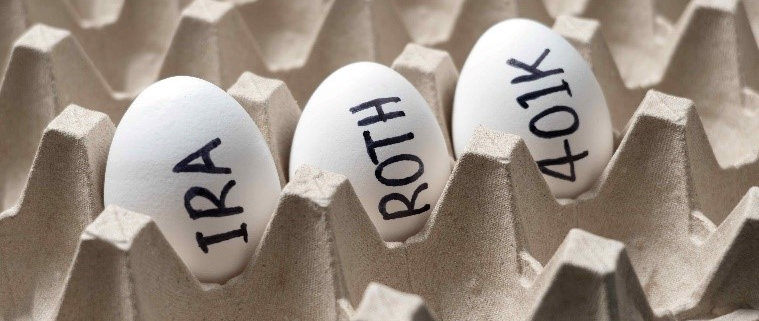

The 401(k) contribution limit - $24,500 or $32,500 if age 50 or older for 2026 - applies to both traditional and Roth accounts. Therefore, if you plan to contribute to both in the same year, you will need to decide how to allocate your contribution up to the annual limit. A financial planner can review your current and predicted future tax situation and make recommendations about how to allocate your retirement savings.
9. Track and manage old 401(k) accounts
A survey conducted by the Bureau of Labor Statistics found that individuals born between 1957 and 1964 held an average of 12.7 jobs between the ages of 18 and 56. Even if only a few of those 12.7 jobs offered 401(k) plans, it’s still safe to assume that most adults accumulate more than one employer-sponsored retirement plan during their working years.
One key component to ensuring you don’t leave retirement money on the table is simply keeping track of your retirement savings when you leave a job.
When you change jobs, you can leave your 401(k) plan as is, roll your 401(k) plan into a new employer’s retirement plan, or roll your 401(k) plan into an Individual Retirement Account (IRA). There are pros and cons to each choice, and it’s important to weigh your options carefully.
The most important factor is to be intentional with your decision. You worked too hard for your retirement savings to risk having them forgotten or lost.
10. Know when maxing out your 401(k) may not make sense
Having a solid retirement income plan is a key component of the financial planning process. However, maximizing your 401(k) contributions is not the right choice for everyone. For some, a more moderate approach to retirement savings will make more sense.

Some reasons NOT to maximize your 401(k) contributions include:
Not having an emergency fund
Establishing an emergency fund is a cornerstone of good financial planning. Being able to pay for an unexpected expense - such as a car or home repair - or weather a difficult financial period - such as the loss of a job - is critical to your long-term financial stability.
Without having money set aside for life’s unexpected twists and turns, you are more likely to take on debt, harm your credit, and become derailed from your long-term financial goals - including retirement. You may even be tempted to dip into your retirement savings to fund an emergency, but that can result in costly penalties and taxes.
It’s better to save for retirement at a more moderate rate - such as by saving enough to receive your full employer match - while simultaneously establishing an emergency fund, before turning your attention to maximizing your 401(k).
Balancing short-, medium-, and long-term goals
Funding your retirement is a critical financial goal. But it is often not the only financial goal. Individuals often have several goals that they are saving for simultaneously, including:
Short-term goals, such as buying a car, making a down payment on a home, or funding a remodeling project
Medium-term goals, such as saving for a child’s college expenses or purchasing a cabin or vacation home
Long-term goals, such as ensuring financial independence in retirement
A comprehensive financial plan must balance these short-, medium-, and long-term goals in a way that optimizes your resources, giving you the greatest chance of success in all areas. Maximizing your 401(k) may result in overreaching on your long-term retirement goal at the detriment of your short- and medium-term goals.
A financial planner can help you compare your retirement income needs and retirement savings rate to determine if you are on track, ahead, or need to maximize your 401(k) to catch up.

Anticipating future taxes
You can’t keep pre-tax assets in a retirement fund forever. The IRS will eventually come for its cut. When you reach a certain age (age 73 as of 2026), you will have to take Required Minimum Distributions (RMDs) from your retirement accounts, including your 401(k) account.
RMDs generate taxable income, on which you will need to pay taxes during retirement. If you are confident that you have enough saved for retirement, continuing to maximize your traditional 401(k) may not be in your long-term best interest. Spreading your savings across different investment opportunities with different tax treatments could be a more comprehensive financial planning strategy.
Final Thoughts
Your 401(k) is a crucial component of your retirement income plan. However, how and whether you maximize it is a personal decision best made with your financial advisor.
Everyone’s financial situation is different. In some cases, you really might be leaving money on the table - if you aren’t taking advantage of an employer match, for example. However, in other cases, maxing out your 401(k) may not be necessary or even prudent for securing your financial future.
Your financial goals may require a different approach. Working with a Certified Financial Planner (CFP®) professional who creates a financial plan tailored to your unique situation and goals is the best approach to help ensure you make the most of your 401(k) in a way that makes the most sense for you!
Contact a Financial Planner Now
FAQs:
1. What is the 401(k) contribution limit for 2026?
For 2026, you can contribute up to $24,500 if you are under age 50. If you are age 50 or older, you can contribute an additional $8,000 as a catch-up, for a total of $32,500.
2. How does an employer match work in a 401(k) plan?
Many employers match a portion of what you contribute to your 401(k). Match formulas vary by plan, but contributing at least enough to receive the full employer match is often an important part of a retirement savings strategy.
3. At what age can you withdraw from a 401(k) without penalty?
Withdrawals from a 401(k) are generally penalty‑free starting at age 59½. Withdrawals before then typically incur a 10% penalty plus income taxes, unless an IRS exception applies.
4. What does vesting mean in a 401(k) plan?
Vesting refers to how much of your employer’s contributions you own. Your own contributions are always fully vested, while employer contributions may become vested over time based on your plan’s schedule.
5. Can you contribute to both a traditional 401(k) and a Roth 401(k)?
Yes. You can contribute to both a traditional and Roth 401(k), as long as your combined total stays within the IRS annual contribution limit.
Sources:
https://www.irs.gov/retirement-plans/401k-plans
https://www.investopedia.com/terms/1/401kplan.asp
https://www.fidelity.com/learning-center/smart-money/how-much-should-i-contribute-to-my-401k
https://www.investopedia.com/articles/retirement/082716/your-401k-whats-ideal-contribution.asp
https://www.investopedia.com/articles/personal-finance/061913/hidden-fees-401ks.asp
https://www.bls.gov/nls/questions-and-answers.htm
https://www.irs.gov/newsroom/401k-limit-increases-to-23500-for-2025-ira-limit-remains-7000
All investment strategies have the potential for profit or loss. Changes in investment strategies, contributions or withdrawals, and economic conditions may significantly alter the performance of your retirement savings accounts. We cannot guarantee that your investments will match or outperform any specific benchmark. Asset allocation, rebalancing, and diversification will not necessarily improve an investor’s returns and cannot eliminate the risk of investment losses.
The views represented are not meant to be construed as advice. Moreover, no client or prospective client should assume that this content serves as the receipt of, or a substitute for, personalized advice from Affiance Financial, or from any other professional.
Content should not be viewed as legal or tax advice. You should always consult an attorney or tax professional regarding your specific legal or tax situation. 401(k), IRA, and tax rules are subject to change any time.
Affiance Financial does not serve as an accountant and does not prepare tax returns.